1. One pricing question, three kinds of work
Say you are building an AI assistant for small clinics that answers patients' messages and books appointments. Every conversation calls a model and costs you money, and a heavy-use clinic costs far more than a light one. How should the assistant earn?
Ask an AI chat and you get a confident answer in seconds. It lists some pricing models, recommends one and works out what a clinic would pay in a typical month.
AI did all of that the same way, yet the answer holds three different kinds of work:
- The recommendation is a judgment about your business. It needs interpretation, so AI belongs here.
- The list was produced without a defined set of possibilities to work within. Nothing in it shows what was left out.
- The monthly figure was already fixed by a pricing rule. Yet the answer gives you no reusable calculation you can check against that rule.
When you build an AI capability, the useful question is how AI should be used in each part of the work, and how much.
2. Three types on one bar
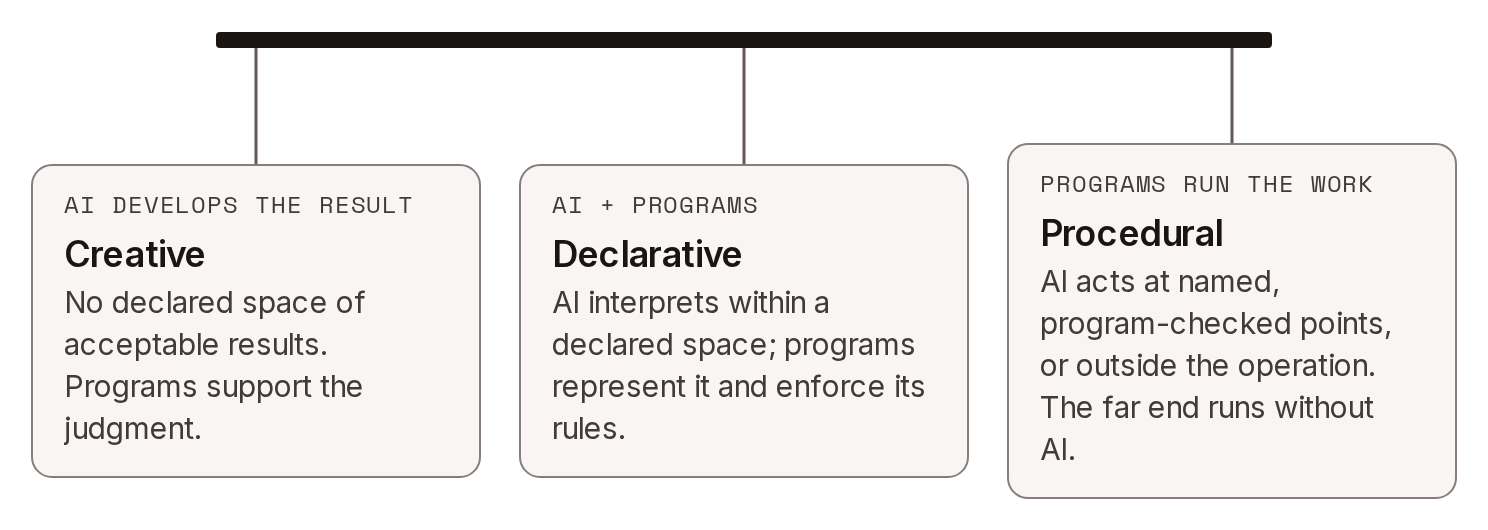
In LeanOS, I distinguish three types of workers by that question, placed along a progress bar. At one end, AI develops the result. At the other, programs run the operation and AI stays outside it. No percentage places a worker on the bar. The definitions mark the positions, and each task finds its place by what it requires.
In plain terms:
- Creative: AI develops the result. It investigates, interprets, invents, argues and recommends, guided by the worker's knowledge and methods, the owner's purpose and the constraints. Nothing declares in advance the space of acceptable results. Programs support it with retrieval, calculation and checks.
- Declarative: AI works inside a declared space: a domain's concepts, distinctions, valid combinations and rules, written down explicitly. AI interprets the request; programs represent the space and enforce its rules. The declared space is what makes a worker declarative.
- Procedural: programs perform the operation. Any AI decision is confined to a named point, and a program checks its output before it is used. At the far end, the operation runs with no AI at all.
Whatever its type, a worker owns one coherent result. It has the knowledge and methods the work requires, knows which decisions it may make and checks what it delivers. Its type declares how AI is used to produce that result.
| Type | Who leads | AI's role | Programs' role | How it's checked | Example |
|---|---|---|---|---|---|
| Creative | AI | Investigates, interprets, invents, argues, recommends | Support: retrieval, calculation, checks | Specialist evaluation of its reasoning and fitness | Monetization Architect |
| Declarative | AI and programs equally | Judges how the request applies and places it in the declared space | Represent the space and enforce its rules | Does the result belong to the declared space? Does it apply to the request? | Monetization Atlas |
| Procedural | Programs | Acts at named points a program checks, or works outside the operation | Perform the operation | Run it: the program ran, the output satisfies the rule, the effects are accounted for | The Architect's calculator; a trading system |
Three qualitative positions on one bar
Creative: AI develops the result through expertise and methods, without a declared space of acceptable results; programs can support retrieval, calculation and checks. Declarative: AI interprets within a declared space and programs represent the space and enforce its rules. Procedural: programs run the operation, with any AI confined to named program-checked points; the far end uses no AI in the operation. No percentages are assigned. These are alternative types, not steps.
3. The clinic question, worked by two workers
For the clinic assistant, how it earns has to be decided together with the product itself. The founder could charge a flat monthly fee per clinic, a fee per staff seat, a price per conversation, a price per booked appointment, or a monthly base that includes a number of conversations. Each choice changes what is measured and built, who carries the model costs and what the founder promises the clinic.
Two LeanOS workers address this question. The Monetization Atlas lays out the ways the assistant could earn. The Monetization Architect develops an offer, its pricing and economics, and recommends a direction. Inside the Architect, a calculator runs the agreed charging rules. The two workers sit at different points on the bar, and the calculator sits further along.
4. Declarative: the Monetization Atlas
The Atlas's declared space is an explicit model of how revenue is earned:
- 15 dimensions of an exchange, including who benefits, who pays, what is sold, the unit of charge, the rule for the amount, the event that creates a payment, the rights granted, who carries the costs, where the product runs and how long the obligation lasts.
- 18 schemes: 10 basic and 8 combined.
- 12 modifiers, such as a free part, tiers or prepaid volume.
- Rules for combining them.
The distinctions do much of the work. What is sold can be a finished result, a copy of a product, a right of use, access to an environment for a paid period, work to order, a maintained state (an outcome the seller keeps true over time), an intermediary's action (something the seller does as a go-between for other parties) or an advertising placement.
"A monthly subscription" names only a payment rhythm and leaves all of that open. For the clinic assistant, it could buy access for a period, or a maintained state: patients' messages answered, whatever their number. The second leaves every extra conversation on the founder's bill.
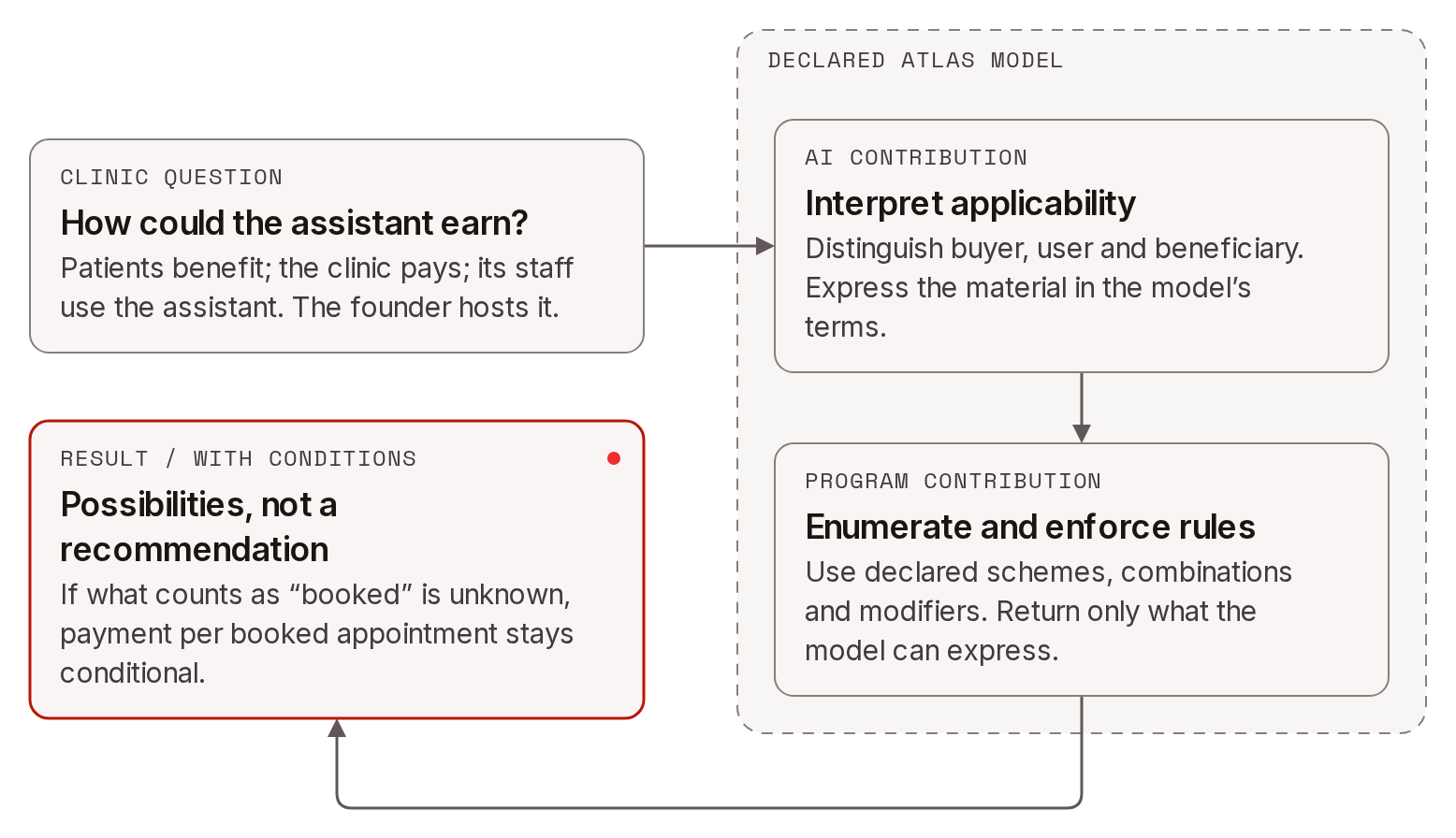
AI interprets the founder's question and places their material in the model's terms. The patients benefit, the clinic pays and its staff use the assistant: three different roles. The founder hosts the assistant, so the model costs sit with the seller. A charge per booked appointment would be a payment on a measured result, which needs an agreed record of what counts as booked.
Programs then enumerate every scheme the model holds for those terms, such as access for a paid period, a maintained service, metered consumption, a base fee plus usage, or payment on a measured result. They check each combination against the model's rules. A possibility that depends on a fact nobody has supplied stays conditional, neither dropped nor assumed.
Because the catalogue of schemes is finite, the result lists every scheme that fits, and says so. Combinations assembled under the rules come with the bounds of the search that produced them. The founder sees every possibility and its conditions, including ones a recommendation would never mention.
AI and programs carry equal weight here: AI judges how the request applies, programs hold the rules. The space also marks the edge of what AI does. It cannot return a scheme the space does not hold, and it does not change the definitions to make one request fit. When a request exposes something the model cannot express, the Atlas reports the gap to the model's maintainer.
The Atlas shows the possibilities and chooses none of them, but that is not what makes it declarative. Other declarative workers select and build within their space: one can assemble an interface from a declared set of components while programs check that they fit together. The declared space is what counts.
AI interprets; programs enforce the declared space
For the clinic assistant, patients benefit, the clinic pays and its staff use it; the founder hosts it. AI maps these roles to the declared model. Programs enumerate schemes and combinations and enforce the rules. For example, if what counts as a booked appointment has not been supplied, payment per booked appointment remains conditional. The Atlas chooses none of the possibilities; belonging to the model and applying to the request are separate checks. A model gap belongs to the maintainer.
5. Creative: the Monetization Architect
The Architect has no declared space of acceptable answers. Its knowledge covers how buyers decide, how rights and costs move between parties and how revenue mechanisms behave, and its methods guide AI through the work. Neither lists in advance what the result may be.
It starts from the founder's purpose, assets and circumstances. For the clinic assistant, it separates three people: the receptionist who works with it, the clinic owner who decides to buy and pays, and the patients it serves. Then it asks what each clinic is trying to get done:
- A small practice wants a predictable monthly cost it can approve at once.
- A busy clinic wants a price that grows with the work the assistant takes off its staff.
- A clinic owner may value booked appointments far more than answered messages.
Each answer points to a different offer. The Architect develops them: what is sold, to whom, on what charging basis, with which rights and obligations, and who carries which costs. It models their economics, compares them against the founder's purpose and constraints, and recommends one with its reasons. Where the uncertainty is decisive, it designs a test that would reduce it.
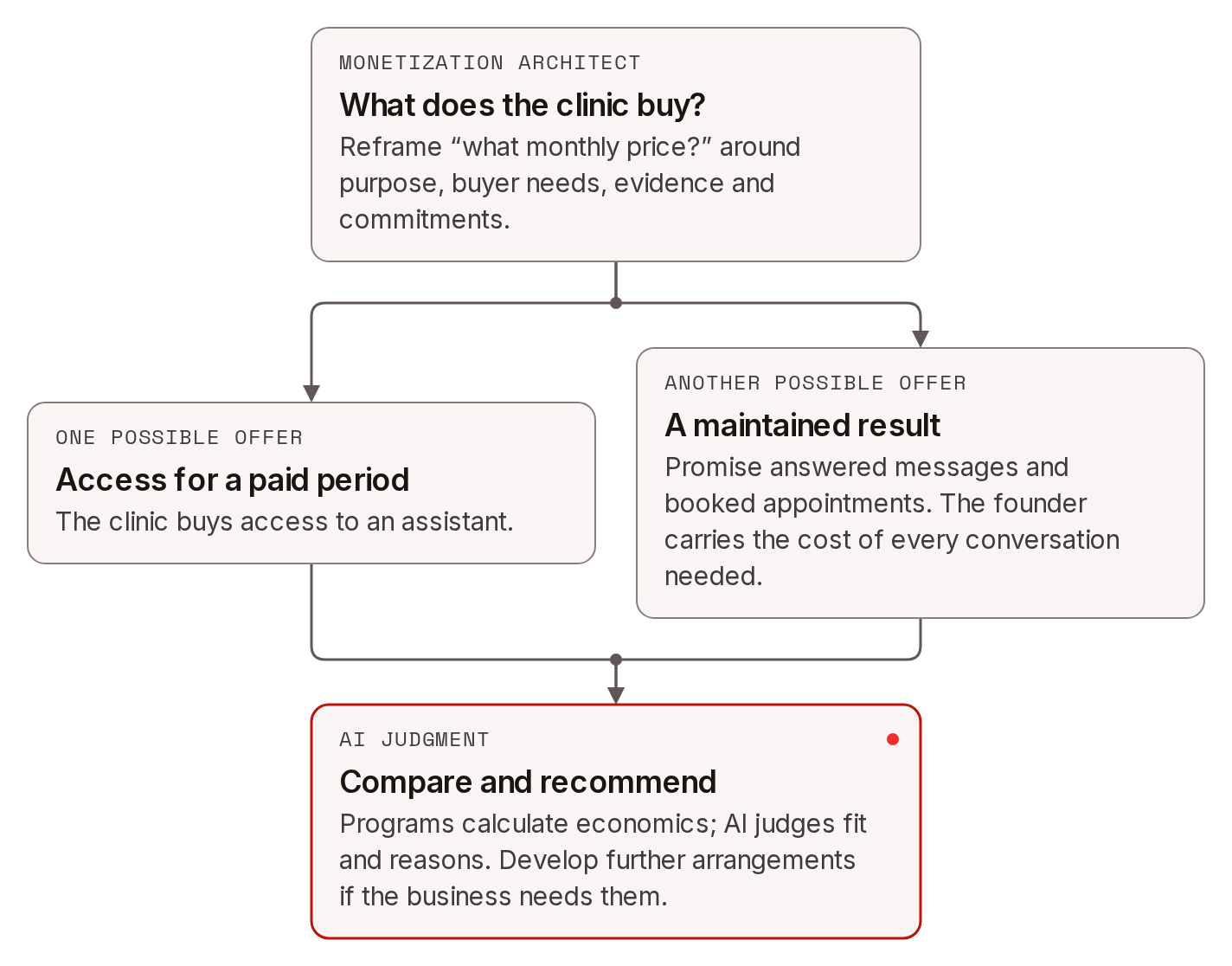
It can change the question. Deciding a monthly price may first require deciding what the clinic buys: access to an assistant, or answered patients and booked appointments. Those are different products with different costs, even at the same price. The second makes the founder responsible for results, and for every conversation it takes to reach them.
Because nothing bounds the result in advance, the Architect can develop an arrangement no model lists, if that serves the business. Two runs on the same question can produce different offers, both sound. The result is judged on its reasoning and its fit with the founder's purpose.
The Architect can work from an Atlas result or directly from the project's material, and the Atlas's map is just as useful to a person or another planner. Each worker stands on its own; together, the possibilities widen what the Architect considers.
The founder decides which offer to adopt and which commitments to make. A recommendation, however well argued, remains a proposal until they accept it. What buyers actually do is learned only from their response.
A price question can become a product question
The Architect can ask what the clinic is buying before deciding a monthly price. Access for a paid period and a promise of answered messages and booked appointments are different offers. The latter makes the founder responsible for the result and the conversations needed to produce it. Programs calculate economics; AI develops alternatives, compares their fit with purpose and evidence, and recommends with reasons. No declared catalogue bounds acceptable answers. The recommendation remains a proposal until the founder accepts.
6. Procedural: the calculator, and a trading system
The Architect uses AI for its judgment, not its arithmetic. Once a charging rule is agreed, a program applies it. Suppose the founder settles on a base fee with included usage: $99 a month per clinic includes 300 conversations, and each additional conversation costs $0.40. The calculator returns:
- 420 conversations in a month: $147.00 (the $99 base plus 120 additional conversations at $0.40).
- 250 conversations: $99.00, since the included conversations cover them.
- A negative quantity: it refuses and names the error.
AI decides nothing here. Whether clinics pay per conversation, whether 300 are included and whether $99 is attractive were settled earlier, in the offer the founder accepted.
The accepted tariff fixes the charge
The agreed tariff is $99 per month per clinic, including 300 conversations, plus $0.40 for each additional conversation. At 420 conversations the excess is 120, so the total is $147.00. At 250 the total is $99.00. Negative quantity is rejected. Exact decimal inputs carry currency, unit, period, source, offer revision and observed, estimated or scenario evidence status. Outputs preserve the relevant context. These are source examples, not claims about market pricing.
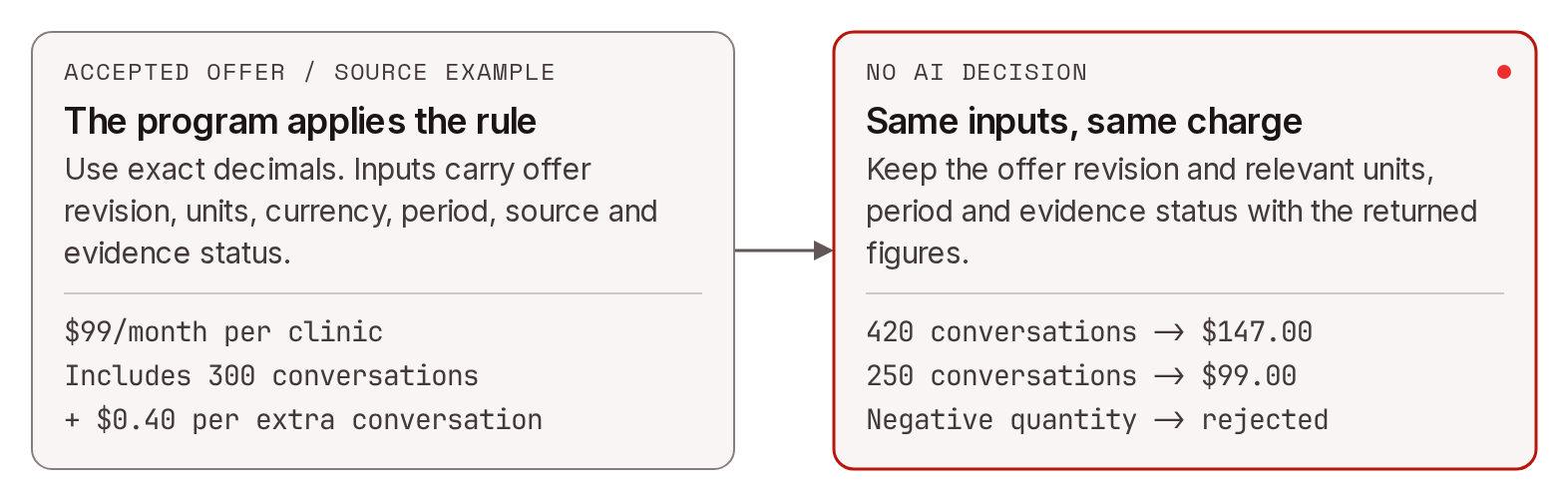
The calculator's inputs state the currency, unit, period, source, the exact revision of the offer, and whether the figures are observed, estimated or a scenario. It accepts amounts only as exact decimals, so the same inputs always give the same charge. Each figure can be rerun, checked against its rule and traced to the offer revision it applied. If the rule is implemented wrongly, the defect is fixed once, in the code.
The same calculator projects revenue and costs over a period, compares scenarios, finds the break-even quantity and tracks prepaid credits. These stay inside the Architect, because they serve its result. Procedural work does not need a worker for each tool; a separate procedural worker makes sense when running the operation is itself the outcome someone needs.
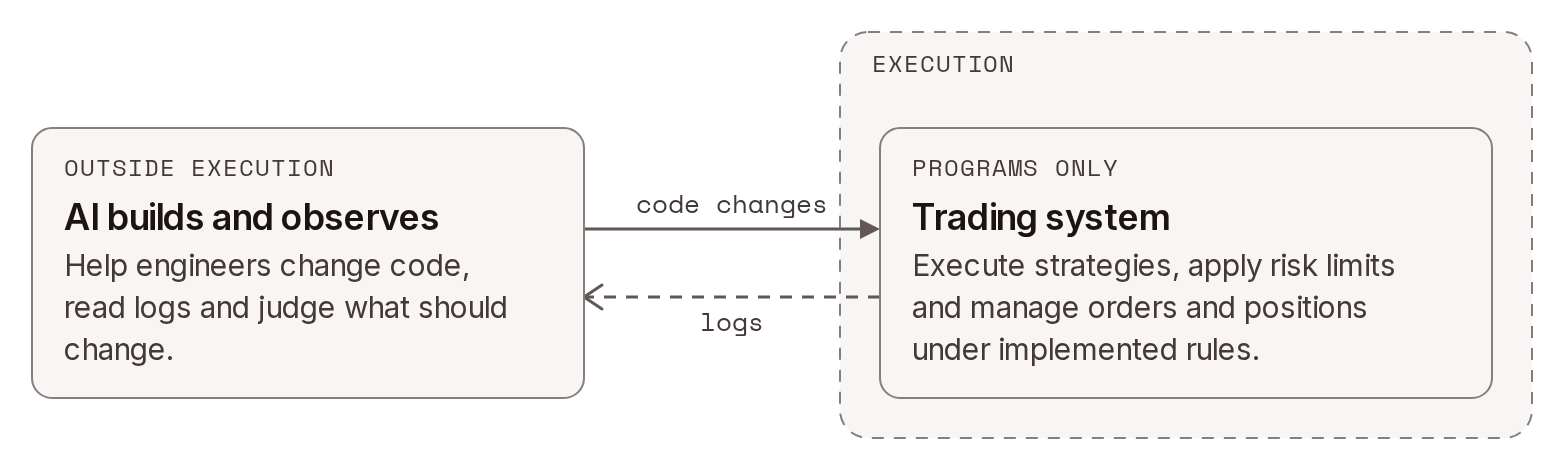
A trading system is one example at the far end of the bar. In this example, programs execute strategies, apply risk limits and manage positions. AI does a great deal around it: it helps engineers build and change the code, reads the logs to find out why a strategy behaved as it did, and judges what should change. That judgment becomes a change to the specification and the code, and the system runs it. AI never places, sizes or cancels a trade.
In this system, every execution decision is fixed in advance: the same inputs and state must produce the same action, traceable to the rule that caused it. AI judgment in the execution path would turn each trade into a fresh interpretation. So AI's contribution goes into the system, and the system does the trading.
Other procedural workers leave AI a bounded role: resolving a named exception at a defined point, with a program checking its output before anything depends on it. Where every decision is already implemented, no AI is involved at all.
Keep AI outside this trading execution
Outside execution, AI helps engineers build and change code, inspect logs and judge improvements. Code changes enter the trading system; logs return for analysis. Inside the execution boundary, programs execute strategies, apply risk limits and manage orders and positions under implemented rules. There is no ordering among these capabilities in this diagram and no AI trading decision. Zero-AI execution is this example at the far end of the bar, not a requirement of every procedural worker.
7. How the work connects
The three kinds of work connect through their results, and each result must carry what the next one needs.
- The Atlas's map passes on its possibilities with their definitions and conditions.
- The Architect combines them with the founder's purpose and evidence into an offer, which must state what is sold, to whom, on what charging basis and with which obligations before the economics can be calculated.
- The calculation takes the matching quantities, costs and period, and returns figures tied to the offer revision it used.
- The recommendation keeps the assumptions behind those figures.
- The founder decides.
Some obligations do not fit into arithmetic. A promise of unlimited conversations for life has no end date, and a twelve-month calculation says nothing about the years after it. So the commitment stays visible beside the figures instead of disappearing into them.
The connection also runs back. When the Architect develops a useful arrangement the Atlas does not contain, its maintainer can add it to the next version of the model, and every later request sees it.
Where to look when something goes wrong:
- A scheme missing from the map is a gap in the Atlas's model, for its maintainer to correct.
- A recommendation built on a wrong assumption about the buyer is corrected in the Architect's method.
- A wrong charge is a defect in the program.
- An offer that should not have been adopted is the founder's decision to revisit.
Each correction improves the part responsible, so the next piece of work starts from a better basis.
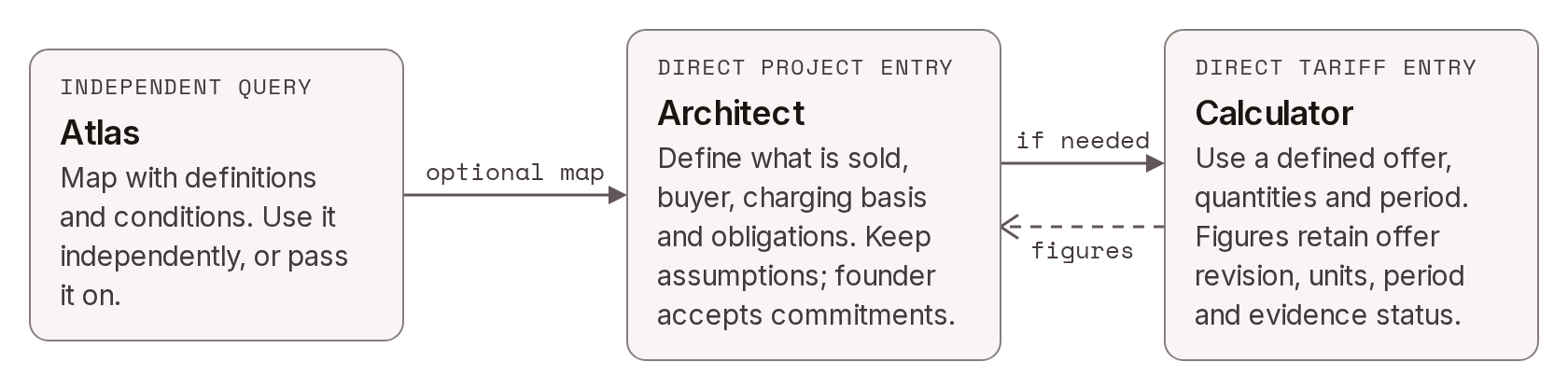
The types describe how AI is used, not a fixed sequence. A question about one tariff can go straight to the calculator. An open question about how to earn may need substantial creative work. An exploration can end with the Atlas's map, for the founder to study alone.
Optional handoffs, explicit decision owners
The Atlas accepts an independent query and returns definitions and conditions; it can stop there or optionally pass its map to the Architect. Project material can enter the Architect directly. The Architect defines what is sold, the buyer, charging basis and obligations; assumptions accompany its recommendation and the founder accepts commitments. If figures are needed, a defined offer with quantities and period goes to the calculator; figures return tied to the offer revision, units, period and evidence status. An agreed tariff can enter the calculator directly. In a separate feedback path, an Architect’s new arrangement reaches the Atlas maintainer, who decides whether to adopt it in a later Atlas revision. It is not automatically admitted during the current request. No task must visit every worker.
Model feedback goes through its maintainer

8. Reading the bar
Along the bar, the lead passes from AI to programs, and each position is checked in its own way (see the table above). Note that a declarative result faces two separate checks: belonging to the declared space, and applying to the request.
People stay at the same place wherever a worker sits. The founder decides what the business is for, which offer it adopts and what it promises customers, because the consequences of those choices fall on them.
Code alone does not decide the type. The Architect runs a calculator and remains creative. An AI engineer making architecture and implementation decisions does creative work, even when the software it builds later runs procedurally. Building the Atlas's model required creative work too; using it is declarative.
Tasks move along the bar with practice. A judgment that recurs can become an explicit rule in a declared space. A rule specified well enough can become a program. Each move narrows what AI must decide and makes more of the work exact.
9. The two-question test
The two-question test has alternative outcomes
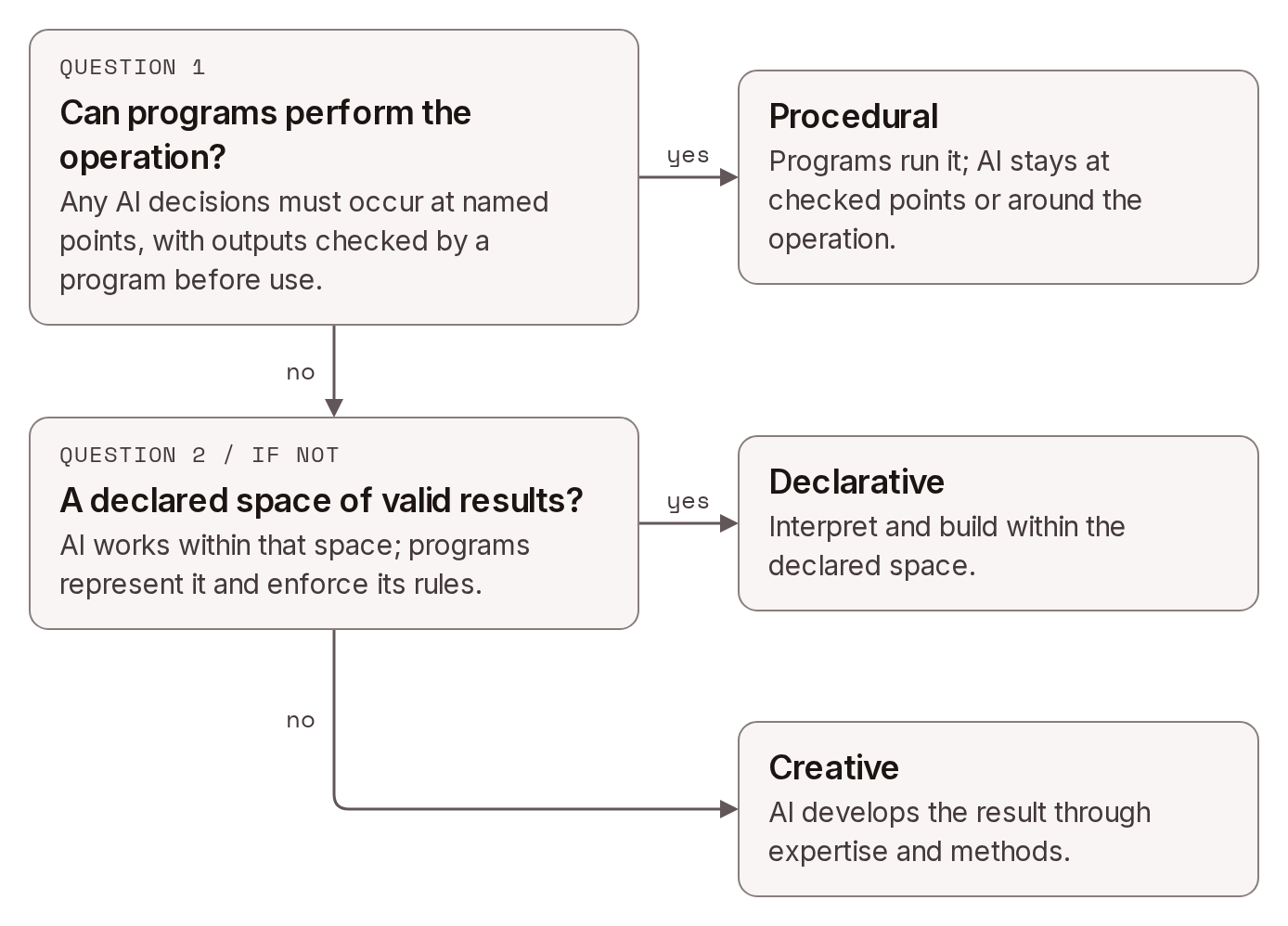
Question 1: can programs perform the operation, with any AI decisions confined to named points whose outputs a program checks before use? Yes selects Procedural. No leads to Question 2: is there a declared space of valid results within which AI operates and whose rules programs represent and enforce? Yes selects Declarative; no selects Creative. The three outcomes have no outgoing arrows. An open pricing recommendation is creative; an Atlas query is declarative; an agreed tariff calculation and an operation with one program-checked AI exception are procedural.
To judge how much AI a task needs, ask two questions about it.
- Can programs perform the operation, with any AI decisions confined to named points whose outputs a program checks? Then programs should run it, with AI confined to those points or working around the operation.
- If not, is there a declared space of valid results within which AI operates and whose rules programs enforce? Then AI works inside that space.
If neither holds, the task needs AI to develop the result, with expertise strong enough for the judgment it makes.
So for the next capability you build, start from the work and what remains to be decided. If the decisions are already made, build the program that carries them out, and use AI to build, observe and improve it. If the work resolves requests within a definable space, declare that space and implement its rules. If it needs investigation, invention or a considered recommendation, give AI the expertise and authority to develop it. The answers choose the type.
This continues the practice described in Operating a business with AI and Engineering when AI writes the code. Understanding the work lets us give AI a real professional responsibility, give programs the operations they can carry exactly and keep the person's decisions connected to the result.